Measured parameters
During the measurements you can analyse the following parameters:
- Dynamic movements: short posture changes in which a threshold is exceeded within four seconds and then returns below that threshold.
- Static postures: postures held for longer than four seconds, in accordance with the EN 1005-4 'Postures' standard.
The classification of movements and postures is based on the configured threshold values for alpha and beta:
- Alpha = trunk inclination: the degree of forward or backward bending of the trunk relative to the neutral posture.
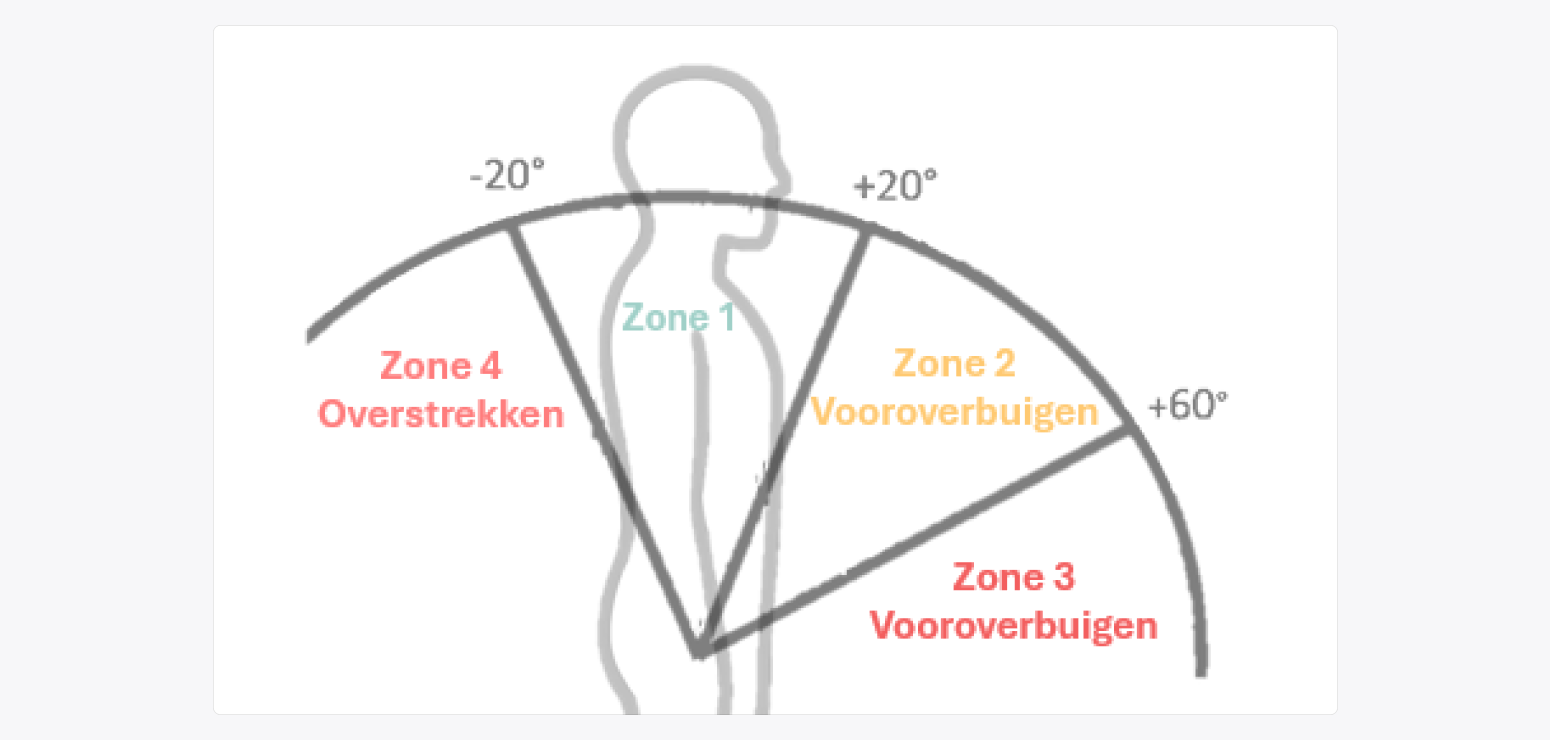
Zone classification for α (trunk inclination):
- Zone 1: −20° to +20°
- Zone 2: +20° to +60°
- Zone 3: > +60°
- Zone 4: < −20°
For Zone 1 and Zone 4 we use adjusted limit values. A threshold of 0° (defined by EN 1005-4 'Postures') would in practice trigger error messages too often during overextension. That is why the limit has been shifted to -20°, so that the measurements are more realistic.
- Beta = back curvature: the extent to which the back is bent (made hollow/round) relative to the neutral posture.
⬇️ Example: someone bends 60° forward with the trunk (α).
- In the first situation β stays at 0°, because the back remains straight.
- In the second situation the back is bent ('rounded back'). As a result β increases to 45° relative to the neutral position.

Dynamic movements
A dynamic movement is a short change of posture that occurs within ≤ 4 s. Movements are detected based on α (how far you tilt) and, depending on the configuration, on β (how you perform that tilt).
Default configuration
- Bending (forward): α ≥ 60° and β ≥ 45°
- Overextension (backward): α ≤ −20° and β ≤ −20°
- Torsion: rotation in the back ≥25° on the time scale (x-axis) of the graph, use CTRL + mouse wheel up or down.
👉 An example: bending forward with a straight back (squat, semi-squat, through the knees) where alpha > 60° but beta < 45°, does not count as a risk movement and does not trigger a vibration signal.
You can adjust these thresholds in the settings. For movements, β can therefore be counted or not, by default it is counted.
The wearables use a hysteresis margin to prevent small variations around a threshold from being incorrectly counted as new movements. This means that:
- A movement is detected as soon as the angle becomes larger than the trigger threshold.
- A new movement is only registered when the angle drops below the reset threshold and then rises above the trigger threshold again.
Example:
- Trigger threshold: 60° (alpha)
- Reset threshold: 50° (alpha)
- A movement in Zone 3 is registered as soon as the alpha angle > 60°.
- A new movement only follows when the alpha angle drops < 50° and then rises > 60° again.
- If the alpha angle stays above 60° without dropping back, this counts as one movement.
An overview of the measured dynamic parameters:
Forward bending (bending)
Normatively, EN 1005-4 focuses on trunk inclination (α). In our default configuration a bend counts as a risk movement when α ≥ 60° and β ≥ 45°. A deep bend with α ≥ 60° but β < 45° (straight back, e.g. squat or semi-squat) does not count as a risk movement and does not trigger a vibration signal.
Backward bending (overextension)
Because α < 0° gives too many false positives in practice, we apply a shifted limit. In the default configuration we register a risk movement at α ≤ −20° in combination with β ≤ −20°.
Rotational movements in the back
We register a torsion when the trunk rotates ≥ 25° relative to the pelvis, away from neutral and then back to neutral. The EN 1005-4 standard uses 10°, but in real-life measurements that gives many false positives (natural trunk sway, small directional corrections, etc.). That is why we only register torsion from 25°: this way we filter out noise and only ergonomically relevant rotational movements remain.
Squat/crouch movements
Squats are detected via our (confidential) model. In addition, we report the squat percentage relative to (squats + bends): the higher this percentage, the more leg use (better technique). Crouching is not reported separately from squats. If you notice a situation where the model performs less well, let us know: that feedback helps us improve.
By default the total movements are shown, but you can also choose to view the movements per 8 hours:
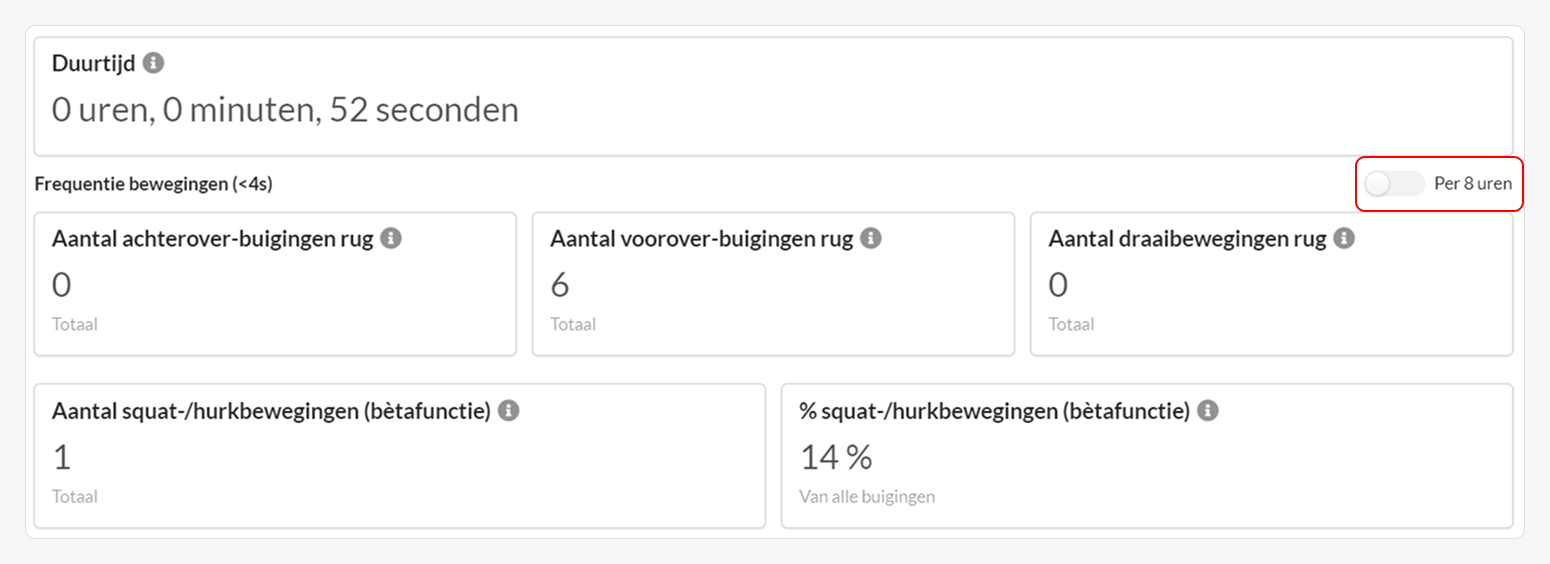
Static postures
Static postures are always and exclusively determined based on alpha (α). The trunk inclination relative to neutral. Beta (β) is never counted for static postures and cannot be activated or adjusted via the settings. The time bar/duration distribution is also entirely α-based and remains unaffected by wearable settings.
We speak of a static posture when an angle is held for longer than 4 seconds (in accordance with EN 1005-4). For α we use the same fixed zones: Zone 1 −20° to +20°, Zone 2 +20° to +60°, Zone 3 > +60°, Zone 4 < −20° (the −20° limit avoids incorrect overextension detections).
Static postures do not take the hysteresis margin into account.
The dynamic parameters that are measured are:
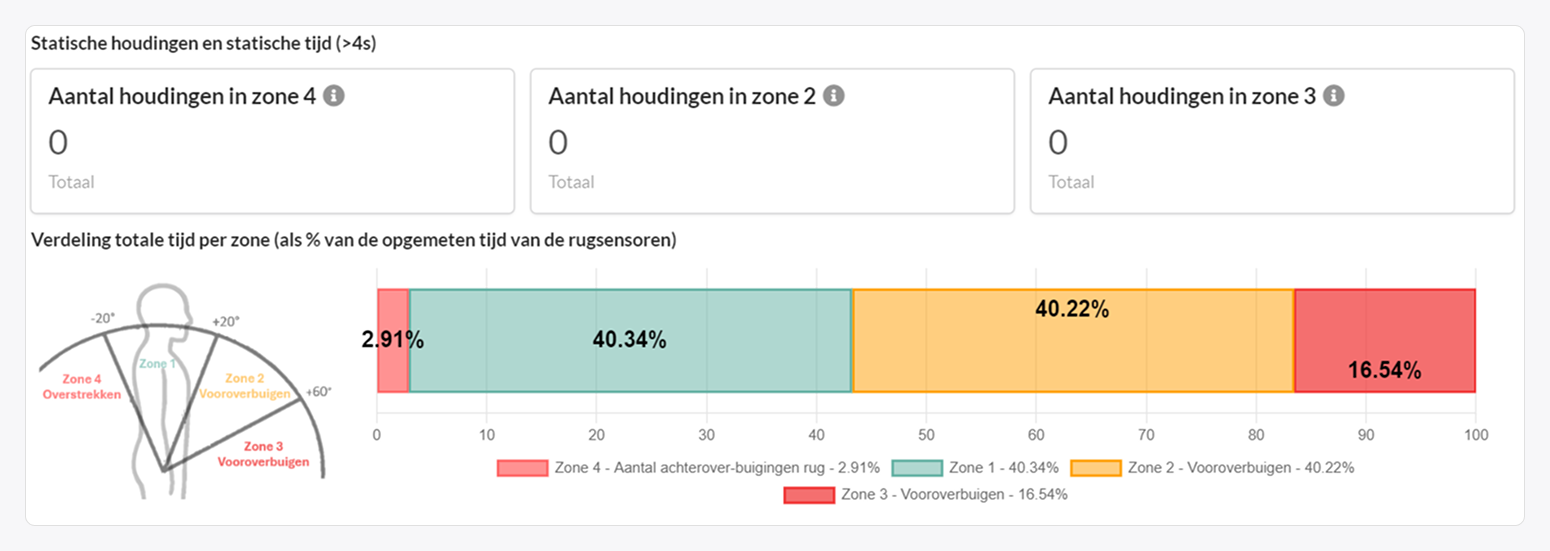
The static postures that are registered are:
- The number of postures in Zone 4 (overextension).
- The number of postures in Zone 2 (forward bending).
- The number of postures in Zone 3 (forward bending).
- The percentage of time in the various zones relative to the total measurement duration.
Vibration signals on risk
When a risk movement or posture is detected, the user receives a vibration signal (if this function is switched on):
- Risk movement (bending or overextension): strong, short vibration signal.
- Forward-bent risk posture: subtle, sustained vibration signal that stops as soon as you return to zone 1.